
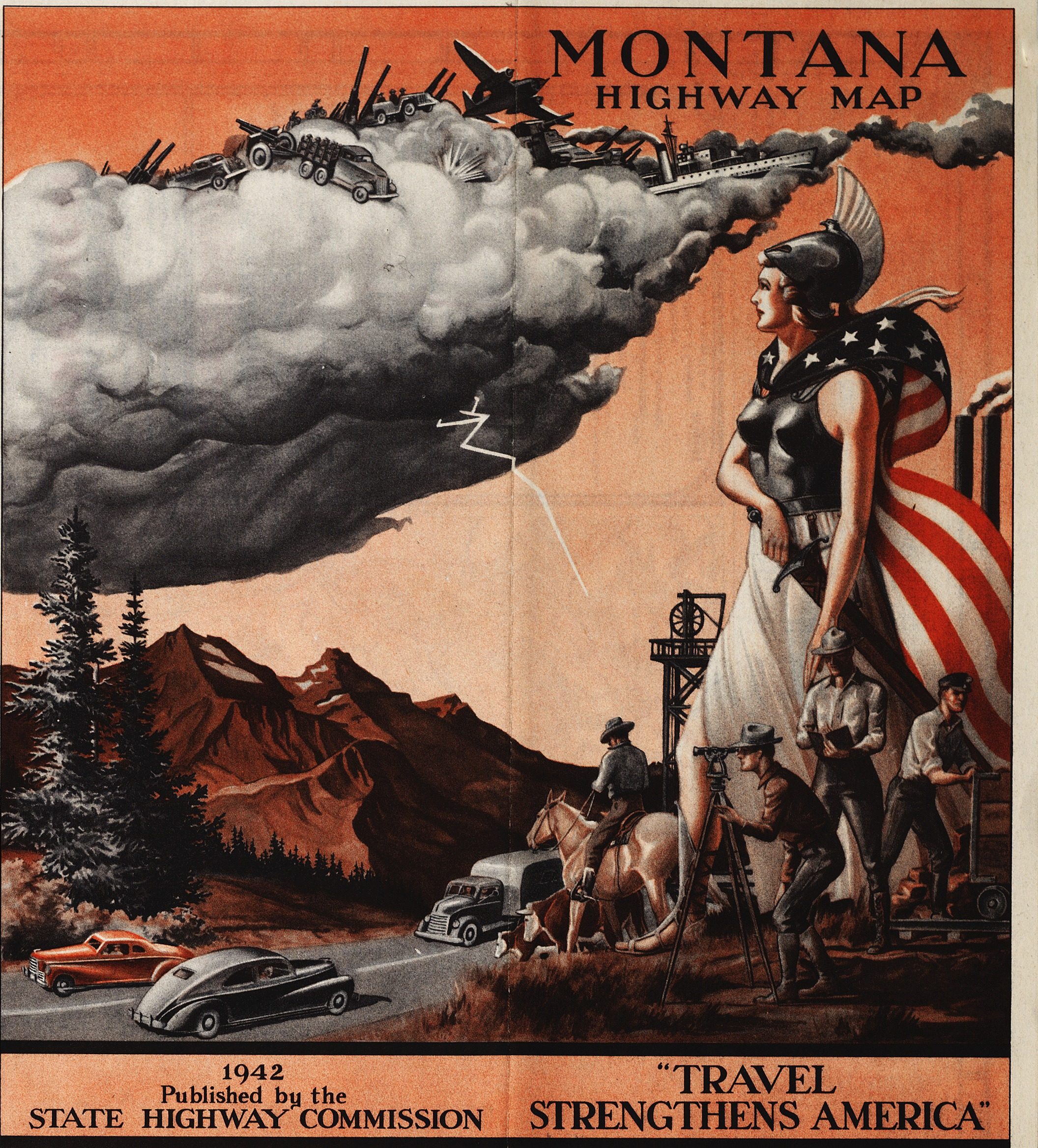
How Montana Shapes Us — And How We Shape Montana
Montana shapes us long before we ever shape it. The distances, the weather, the light, the mountains and plains, the towns stitched along rivers and rail lines — this place teaches us how to live here. It asks things of us. It sets the terms. It shapes our habits, our expectations, our sense of what’s possible.
And every generation of Montanans has answered that challenge in its own way. We adapt. We build. We repair. We imagine. We leave marks on the land and on our communities — marks that outlast us, marks that become the world the next generation inherits.
That exchange — between people and place — is the story of Montana. A story of adaptation, resilience, invention, and the constant negotiation between what the land demands and what people dream it could be.
One of the most profound moments in that long story came during the New Deal era, when Montanans and the federal government reshaped the state together. Not just with dams or courthouses, but with shelterbelts, grazing districts, electrification lines, schools, roads, surveys, community plans, and thousands of acts of everyday labor.
Those choices still shape the Montana we live in today — rural and urban, reservation and town, mountains and plains. They shaped how our communities function, how our landscapes look, how our institutions work, and how we understand what it means to live here.
This project exists to bring that history back into view. To show how the world around us came to be. To understand what it means for us now. And to invite every Montanan — wherever you live — to see your place with new eyes.
Reconnecting Montana with the Stories That Built Us
Every place in Montana carries a history — not just in archives or old photographs, but in the way our communities look, function, and feel today. The layout of a town. The curve of a road. The presence of a shelterbelt. The school at the center of a neighborhood. The way a county courthouse anchors civic life. These aren’t accidents. They’re the result of choices, struggles, and acts of imagination made by people who lived here before us.
But over time, the stories behind those choices fade. The reasons get lost. The connections disappear. And we’re left living inside a landscape shaped by decisions we no longer remember.
This project exists to reconnect those threads — to bring back the stories that built the Montana we know. Not as nostalgia, and not as a museum piece, but as a way of understanding how our world came to be, and how people adapted to the challenges of their time.
During the New Deal era, Montanans faced drought, economic collapse, ecological crisis, and the need to rebuild entire systems of community life. Their response reshaped the state — rural and urban, reservation and town, mountains and plains — in ways that still define us.
By uncovering these stories, we’re reconnecting Montana with its own memory. We’re making visible the foundations beneath our feet. And we’re inviting every Montanan to see their place — wherever it is — as part of a larger, living story.

What This Project Is
This project is about connection — to place, to memory, to one another. It begins with a simple truth: the Montana we live in today didn’t appear out of nowhere. It was shaped by decisions, struggles, and acts of imagination made by people who came before us. Some of those stories are well‑known. Most are not. But all of them live in the places we move through every day.
This project works to make those connections visible again. We document how communities across Montana — rural and urban, reservation and town — adapted to crisis, rebuilt their institutions, reshaped their landscapes, and imagined new futures during one of the most transformative eras in our history: the New Deal.
But this isn’t just a history project. It’s a project about belonging.
Because when you understand how your place came to be — why your town looks the way it does, why your county works the way it does, why your landscape carries the marks it does — you understand something about yourself, too.
This project exists to help Montanans reconnect with the deeper story of the places we call home. To show how ordinary people shaped the world we inherited. To reveal the systems and choices that still guide our daily lives. To strengthen the ties between communities and their pasts. And to remind us that adaptation — the ongoing exchange between people and place — is one of Montana’s oldest traditions.
What this project is, at its core, is an invitation: to look closer, to understand more deeply, and to see Montana not just as a landscape, but as a living story we’re all part of.

Why This Work Matters
Because the places we live in didn’t just happen — they were shaped. By drought and hope, by policy and imagination, by the hands and decisions of people who faced challenges we can still recognize today. When we understand how our world was built, we understand something essential about who we are, and how we got here.
Because Montana’s story is bigger than any single town, county, or community. It’s a shared landscape — rural and urban, reservation and town, mountains and plains — connected by histories that cross boundaries and generations. When we reconnect those stories, we reconnect ourselves to one another.
Because the New Deal wasn’t just a federal moment — it was a Montana moment. It reshaped how we work, how we govern, how we use land, how we build community, and how we adapt to crisis. Its marks are everywhere, even when we don’t see them. Understanding that history helps us understand the systems we live inside today.
Because knowing where we come from helps us decide where we’re going. The choices made in the 1930s still shape our roads, our schools, our counties, our landscapes, and our institutions. When we make those connections visible, we give Montanans the tools to think more clearly about the future — what we want to preserve, what we want to change, and what we want to build next.
Because every community deserves to see itself in the story of this place. Not just the big projects or the famous moments, but the everyday work: the tree plantings, the surveys, the classrooms, the grazing districts, the electrification lines, the small-town decisions that shaped entire counties. These stories belong to all of us.
This work matters because it restores memory. It strengthens belonging. It reconnects Montana with the stories that built us — and the stories we’re still writing.

County Ambassadors: A Statewide Network of Local Experts
Every county in Montana has a story — and each deserves to be told by the people who know it best.
The County Ambassador Program empowers local museum directors, historians, educators, and community leaders to serve as the primary stewards of their county’s New Deal heritage.
Ambassadors help:
-
Share local knowledge and community memory
-
Guide research and site documentation
-
Ensure accuracy and cultural context
-
Represent their county in the statewide archive
This project grows through relationships. Every ambassador strengthens the whole.

How to Explore the Site
This site is designed to help you move through Montana’s New Deal landscape with clarity and purpose.
You can explore by:
-
County Atlas — every county, one place at a time
-
Cultural Landscape Archive — themes, maps, and interpretive essays
-
Tribal Nations — sovereign histories and New Deal-era impacts
-
Galleries & Fieldwork — photos, site visits, and documentation
-
Resources — tools for museums, educators, and youth programs
Whether you’re a researcher, a student, a museum professional, or a curious traveler, this site is your guide.

Join the Partnership
We are building this archive together — county by county, museum by museum, story by story.
If your county does not yet have an ambassador, or if you’d like to collaborate, we welcome you.
Your knowledge matters. Your community matters. Your story belongs here.
A statewide, relationship‑driven effort to honor Montana’s heritage through care, collaboration, and place‑based storytelling.
The Montana New Deal Heritage Partnership is a collaborative, place‑based initiative to rediscover the legacy of the Civilian Conservation Corps, Works Progress Administration, and other New Deal programs across Montana.
We work county by county, community by community, to build a living archive of the places, people, and stories that still shape our cultural landscape today.
Montana’s New Deal history is not just a chapter in a book — it’s a living inheritance. It’s the trails we walk, the schools we gather in, the dams and ditches that sustain our farms, the murals that tell our stories, and the public lands that define our sense of place.
This project exists to:
-
Preserve community memory
-
Strengthen local museums and historical societies
-
Support youth leadership and experiential learning
-
Build a statewide network of partners
-
Reframe the New Deal as a story of land, labor, and resilience

Mission Statement
The Montana New Deal Heritage Partnership documents, maps, and interprets the enduring legacy of New Deal and successor programs across Montana. Through archival research, field documentation, GIS mapping, and community collaboration, we reconstruct how federal initiatives reshaped the state’s cultural landscapes, governance systems, and ecological conditions — and we make this history accessible to the public, to communities, and to future generations.
Vision Statement
We envision a Montana where the full story of the New Deal’s impact is preserved, understood, and shared statewide — a story rooted in the land, in community memory, and in the lived experiences of Montanans. Our goal is to build a collaborative, statewide network of museums, Tribal cultural departments, agencies, scholars, and communities who together steward this history, strengthen local heritage resources, and illuminate the New Deal’s ongoing influence on Montana’s landscapes, institutions, and everyday life.
Why Join Us
- Shared Knowledge: Access digitized archival materials, county‑level research, GIS layers, and interpretive tools.
- Increased Visibility: Your institution becomes part of a statewide initiative featured in StoryMaps, presentations, and centennial programming.
- Strengthened Collections: We help identify, digitize, and contextualize materials in your holdings.
- Community Impact: Resources for local history, heritage tourism, curriculum development, and preservation planning.
- Collaborative Infrastructure: Join a network of museums, Tribal Nations, agencies, scholars, and communities.
What We’re Building
The Montana New Deal Heritage Partnership is creating the first comprehensive, statewide reconstruction of Montana’s New Deal landscape. This includes digitized archives, GIS maps, county‑level histories, StoryMaps, and public‑facing interpretive tools that connect communities to their heritage.
Our goal is to create a durable research and public‑history infrastructure that will serve Montana for decades.
The New Deal in Montana at a Glance
- 8,000+ civic and sanitation projects
- Dozens of dams, reservoirs, and irrigation systems
- Hundreds of miles of roads, trails, and firebreaks
- REA cooperatives that electrified rural Montana
- Wildlife refuges and habitat systems
- Grazing districts and conservation districts
- Schools, courthouses, hospitals, airports, and parks
Decade Pages
1910–1932: Pre–New Deal Conditions
Montana entered the 1930s in a state of deep environmental, economic, and social crisis. Boom‑and‑ bust cycles, homestead failures, drought, overgrazing, and declining infrastructure set the stage for sweeping federal intervention.
- Overgrazed rangelands
- Eroded wheat fields
- Failed irrigation systems
- Declining wildlife populations
- Minimal electrification
- Underfunded schools and hospitals
- Frequent droughts and dust storms
1933–1935: Relief & Emergency Programs
- CCC established (1933)
- PWA begins Fort Peck Dam
- AAA acreage reduction
- FERA and CWA emergency jobs
- Early WPA projects
1936–1939: Institution Building & Conservation
- SCS established (1935)
- RA/FSA land projects expand
- REA electrification begins
- Montana Grass Conservation Act (1939)
- 181 water projects built
- 27 state grazing districts created
- CCC peaks with 40,868 enrollees
1940–1946: War, Transition & Legacy
- Fort Peck Dam completed (1940)
- Charles M. Russell NWR expanded (1942)
- Smokejumpers introduced (1940)
- REA electrification accelerates
- Watershed programs expand
1947–1960: Post–New Deal Impacts
- REA cooperatives expand
- Conservation districts strengthen
- Grazing districts stabilize rangelands
- Irrigation systems modernize
- Wildlife refuges expand
How You Can Participate
- Share archival materials
- Host a presentation
- Collaborate on a StoryMap
- Provide access to local records
- Partner on research
- Contribute oral histories
- Help identify New Deal sites
What We Offer Communities
- Digitized Archival Materials: Photographs, scrapbooks, camp newspapers, maps.
- Local Project Histories: County‑level New Deal summaries.
- GIS Maps & StoryMaps: CCC camps, WPA works, RA/FSA tracts, SCS landscapes.
- Exhibit‑Ready Content: Text, images, and interpretive materials.
- Public Presentations: Talks for museums, libraries, schools, and Tribal communities.
- Heritage Tourism Support: Tools for highlighting local New Deal sites.
- Centennial Programming: Resources for upcoming New Deal centennials.
How to Use This Site
- Explore the County Atlas
- Visit the Archives & Partners Directory
- View Maps & StoryMaps
- Learn About the Project
- Get Involved
Project Collaborators & Lead Researcher
The Montana New Deal Heritage Partnership is built through interdisciplinary collaboration across historical geography, environmental history, ecology, agriculture and range science, New Deal studies, American West history, Montana regional studies, and Tribal leadership and scholarship.
Lead Researcher: Christopher Maschino, M.A.
Responsible for research coordination, archival strategy, GIS mapping oversight, and field documentation for the Montana New Deal Heritage Partnership.
COUNTY AMBASSADOR PROGRAM
A Statewide Network of Local Experts
Every county in Montana has a story — and each deserves to be told by the people who know it best.
The County Ambassador Program empowers local museum directors, historians, educators, and community leaders to serve as the primary stewards of their county’s New Deal heritage.
Ambassadors help:
Share local knowledge and community memory
Guide research and site documentation
Ensure accuracy and cultural context
Represent their county in the statewide archive
This project grows through relationships.
Every ambassador strengthens the whole.